Using Data to Expand Naloxone Access Across Kentucky
In recognition of International Overdose Awareness Day on Aug. 31, the Kentucky Injury Prevention and Research Center (KIPRC) is highlighting naloxone distribution across the state. Naloxone is a safe, easy‑to‑administer medication that can reverse an opioid overdose, and expanding access to it remains one of the most effective ways communities can prevent fatal overdoses.
Naloxone can be given as a nasal spray by bystanders, friends, family members and first responders. According to the Centers for Disease Control and Prevention (CDC), Naloxone is a life‑saving medication that can reverse an overdose from opioids, including heroin, fentanyl and prescription opioid medications. Having naloxone widely available helps ensure that someone can act quickly during an overdose emergency.
As part of its Overdose Data to Action (OD2A) grant from the CDC, KIPRC awards funds to selected local health departments and organizations to provide drug overdose prevention services, such as naloxone distribution. Additionally, KIPRC monitors statewide drug overdose data to help local communities understand their drug overdose burden.
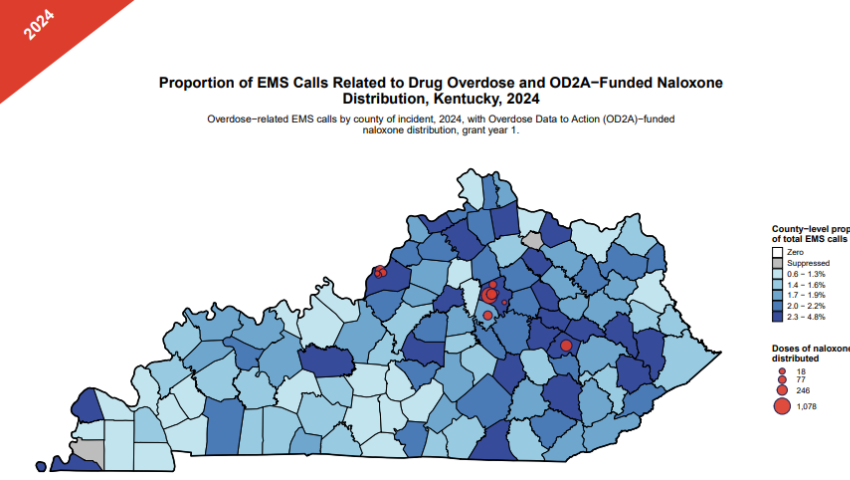
To better understand where the overdose burden is highest and how OD2A-sponsored partners are expanding naloxone access, KIPRC created the Naloxone Mapbook. Epidemiologist Mira Mirzaian, MPH, explains the mapbook overlays naloxone distribution in OD2A subawardee counties with drug overdose-related emergency medical services (EMS) calls, displaying the data at the ZIP code level.
“ZIP code‑level data show differences you simply can’t see at the county level,” said Mirzaian. “Some counties have naloxone distribution concentrated in one ZIP code, while others span several, and that detail helps partners understand where naloxone is reaching people and where gaps may exist.” The data show thousands of doses distributed across Kentucky in 2024 and 2025, with notable increases in OD2A-supported counties:
- Jessamine County increased distribution from 148 doses in 2024 to 3,006 doses in 2025, concentrated in ZIP code 40356.
- Jefferson County’s 40202 ZIP code saw 2,511 doses distributed in 2025, up from 218 the year before.
- Fayette County continued high distribution, with 1,144 doses in ZIP code 40504 and 1,257 doses in ZIP code 40508 in 2025.
- Lee County distributed 374 doses in 2024 and 237 doses in 2025, through both the physical location and mobile efforts.
These increases reflect expanded outreach and ongoing efforts to improve access to naloxone in communities across Kentucky. Greater distribution can indicate that partners are reaching more people, expanding access points, and responding to geographic areas with higher overdose risk.
“These maps are descriptive tools, not explanations,” Mirzaian said. “Higher distribution doesn’t automatically mean higher need, but it often reflects expanded outreach and efforts to improve access.”
Creative, community‑specific strategies
OD2A partners across Kentucky are using a mix of brick‑and‑mortar access points, mobile outreach, and community-based strategies to get naloxone into the hands of people who need it most.
“OD2A partners are incredibly creative,” said Jessie Hicks, MPA, community intervention program manager at KIPRC. “They listen to their communities and find ways to meet people exactly where they are, whether that’s a Goodwill center in Louisville or a mobile unit in rural Kentucky.”
Hicks highlighted examples including Louisville Metro Department of Public Health and Wellness’ weekly presence at the Goodwill Opportunity Center and Kentucky River District Health Department’s mobile unit serving rural areas with limited transportation access.
“Innovative approaches such as mobile units, NaloxBoxes and leave‑behind programs help break down barriers like stigma, transportation and uneven access,” she said. “Without them, many people simply wouldn’t have a way to get naloxone.”
Naloxone distribution looks different in every community, and OD2A partners tailor their strategies to match local needs. Whether through fixed locations, mobile outreach or community events, each partner plays a critical role in expanding access and ensuring that naloxone reaches people who may witness an overdose.
- Lee County distributes naloxone through its physical location, called the HUB, a mobile unit and community events.
- Voices of Hope in Fayette County uses its Recovery Community Center, the Medication Oriented Recovery and Enhancement (MORE) mobile unit and event outreach.
- Louisville Metro distributes naloxone daily at the downtown health department and weekly at the Goodwill Opportunity Center.
- Jessamine County partners with EMS on a naloxone leave‑behind program, maintains purple NaloxBoxes across the community and hands out naloxone at public events.
Understanding the geographic patterns
Effective overdose prevention depends on understanding both community needs and the reach of existing resources. The Naloxone Mapbook provides local partners with a way to evaluate naloxone distribution of OD2A funded doses alongside overdose-related EMS calls, helping inform future prevention and outreach efforts.
“OD2A trusts partners to lead with their local expertise,” Hicks said. “When overdose patterns shift, partners adapt, whether that means adding NaloxBoxes in Jessamine County or expanding mobile outreach in Lexington.”
Through the remainder of the five-year OD2A grant that ends in September 2028, KIPRC partners will continue to explore the best routes for naloxone distribution and access, supporting communities and preventing overdose deaths across the state. KIPRC is proud to be a part of these efforts and to support the decline of overdoses on International Overdose Awareness Day.
For help finding naloxone in your area, visit https://findnaloxone.ky.gov or https://findhelpnow.org/ky.
KIPRC, a unique partnership between the Kentucky Department for Public Health (DPH) and the University of Kentucky College of Public Health, serves both as an academic injury prevention research center and as the DPH’s designee or “bona fide agent” for statewide injury prevention and control, focusing on injury prevention translation and practice.
This project is supported by the Centers for Disease Control and Prevention of the U.S. Department of Health and Human Services (HHS) as part of a financial assistance award totaling $5,407,419 with 100% funded by CDC/HHS. The contents are those of the author(s) and do not necessarily represent the official views of, nor an endorsement, by CDC/HHS, or the U.S. Government.